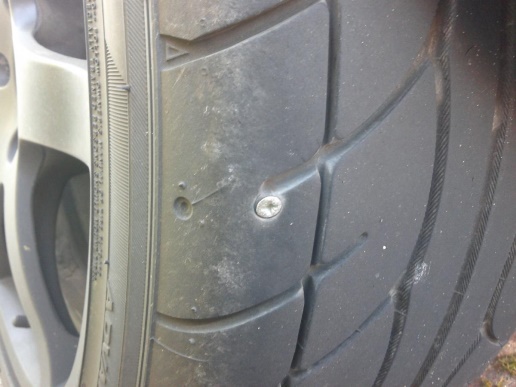
First: do not drive on it flat
A tyre driven even a short distance with no air in it crushes the sidewall from the inside. That turns a repairable puncture into a scrap tyre, and it can damage the wheel. If the tyre is flat or close to it, stop somewhere safe and change to the spare, or call for help.
A slow puncture is different, but do not leave it. Topping a tyre up every few days still means it runs low between top-ups, which weakens the carcass. If the tyre pressure warning light keeps coming back, there is usually a nail or screw behind it.
Already on the roadside? Established customers can use our 24/7 breakdown cover in Waterford and South Kilkenny.
Which punctures we can repair
We repair the central tread area only, to EU practice. The tyre comes off the wheel and is inspected from the inside, because the damage you cannot see matters more than the hole you can. If it passes, the injury is filled and patched from the inside so it is sealed for good.
As a rule, a car tyre can be repaired if the hole is in the central part of the tread and small, around the size of a screw or nail. Anything in the shoulder or the sidewall, a cut rather than a hole, or a tyre that has been run flat, is a replacement. We will show you the damage on the tyre before you decide.
| Damage | Repairable? | Why |
|---|---|---|
| Nail or screw in the central tread | Usually | The area the repair standard allows |
| Hole in the shoulder | No | It flexes too much to hold a repair |
| Sidewall cut, bulge or hole | No | The sidewall carries the load |
| Tyre driven flat | Usually not | The inside of the sidewall is crushed |
| Old repair close by | Depends | Repairs cannot overlap |
Run-flats, sealant and inflator kits
Run-flat tyres let you keep going for a limited distance after a puncture. Many manufacturers do not want them repaired once they have been driven deflated, because the damage is inside the tyre. We inspect and tell you straight.
Many new cars come with a compressor and a bottle of sealant instead of a spare. The sealant gets you moving, but it coats the inside of the tyre and can ruin a puncture we could otherwise have repaired. It can also clog a tyre pressure sensor. If you have used the can, tell us before we take the wheel off.
If your car has no spare, we can often fit one. See spare wheel kits for the options.
Space-savers and plugs
A space-saver is only there to get you home or to us. The speed limit is printed on the wheel or the sidewall, usually 80 km/h (50 mph). Do not use it for a week of school runs, and do not take it on the motorway.
A string plug pushed in from the outside is a roadside emergency fix, not a repair. It does not let anyone check the inside of the tyre, and we will not send a plug-only tyre back out on the road.
Where to bring it
Cars, vans and 4x4s go to Grattan Quay on 051 873777. Truck, trailer and agri punctures go to Newrath on 051 857666. Bring the car if you can, not just the wheel in the boot, so we can check the pressure sensor and the other tyres too.
If the tyre cannot be saved, we quote a replacement there and then. Not sure of the size? See how to read a tyre size, or book a puncture repair and we will read it off the car.
Questions we get at the counter
Can a sidewall puncture be repaired?
No. The sidewall flexes and carries the weight of the car, so a repair there is not safe. It is always a replacement.
Can a run-flat tyre be repaired?
Sometimes, if it has not been driven flat and the manufacturer allows it. Many do not. We inspect it from the inside and tell you which applies.
Is a plug from a repair kit safe?
Only to get you to a tyre shop. It is not a permanent repair, because nobody has checked the inside of the tyre.
I used the sealant kit. Can you still repair it?
Sometimes. Tell us before we remove the tyre. Sealant can make a repair impossible and can block a TPMS sensor, so we need to clean and check it.
Send an enquiry
If you want us to read the size off the car, or quote a set, make an enquiry. We call you back. You pay in the workshop, not here.